Solar farm security with an off-grid Mobile Tower Platform
A solar farm exports megawatts and offers nothing at the fence line. What that means for perimeter detection, and how an off-grid mast platform closes the gap.
In this article
Your client’s solar farm generates power on every square metre and gives you none of it where you need it. No socket at the fence, no pole, no duct, no fibre. The panels are valuable, the cable between them is worth more per kilo, and the site sits far enough from anywhere that nobody hears the van pull up. The security spec still has to work.
Ten hectares of panels, a stock fence around the edge, and not one usable power point along it. That is the perimeter you have been asked to cover, and the client wants a price this week.
Solar farm security is awkward for reasons that have nothing to do with cameras. This article breaks down what changes between the construction phase and the operational phase, what a working detection position actually needs, and how an off-grid Mobile Tower Platform gives you that position on a site that offers you nothing to build on.
Why a solar farm resists conventional perimeter security
Three things make the site harder than it looks on the drawing.
The value is spread thin over a lot of ground. A utility scale array puts high value hardware across tens of hectares behind a fence that was specified for livestock and planning conditions, not for intrusion. A breach on the far side of the array can run for hours, because there is nothing out there to notice it.
The infrastructure runs the wrong way. Everything on the site is built to export power, not to distribute it. Inverter stations and the substation are locked, metered and someone else’s responsibility. Tapping into them for a camera position means an electrical design change, an outage window and a conversation with the asset owner. Most integrators never get that conversation.
The target moves. During construction it is panels on pallets and cable on drums. At commissioning it is inverters and transformers. Once the site is live it is copper, and usually the same trench line twice. A fixed camera position specified in month one is pointed at the wrong part of the site by month nine.
What a working detection position needs
Strip the brochures away and it comes down to four requirements.
- Elevation. Six metres turns a hedge line into a sightline and gives video analytics the depression angle they need to separate a person from a fox. At ground level, analytics guess.
- Power measured in weeks, not hours. A generator on a solar site is an awkward look and a refuelling schedule nobody wants to own.
- A route back to the alarm receiving centre. Usually 4G or LTE, because there is no fibre in the field.
- Something that stays still in wind. Every camera wobble is a motion event, and every false motion event costs the ARC money and costs you credibility.
The site supplies none of the four. So the position has to bring all of it.
Solar power at the perimeter, not just in the field
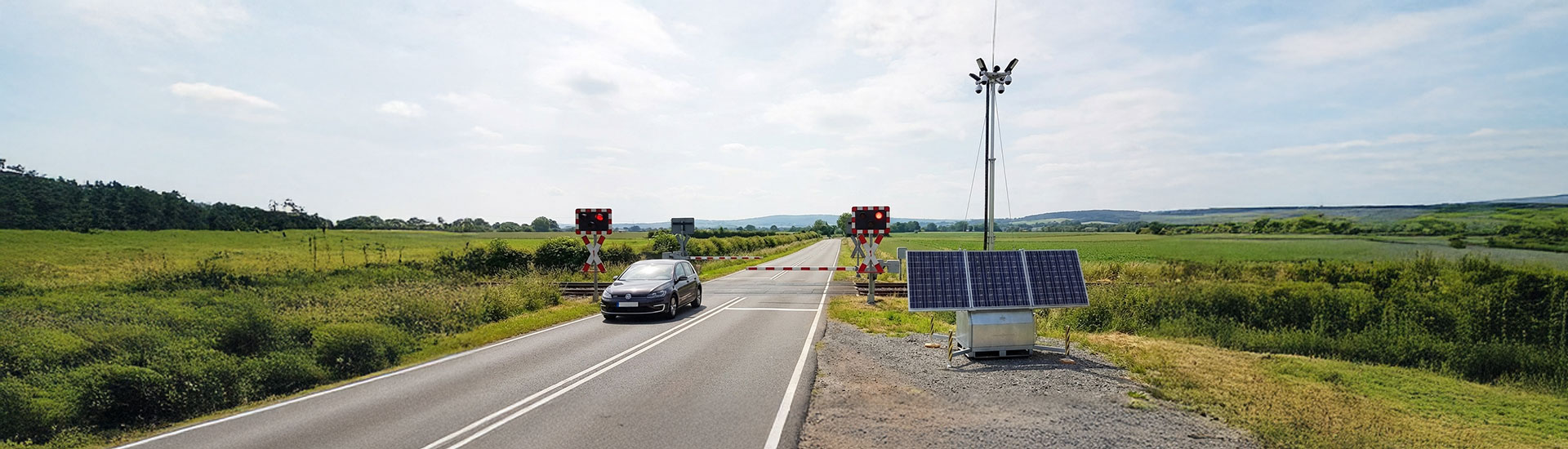
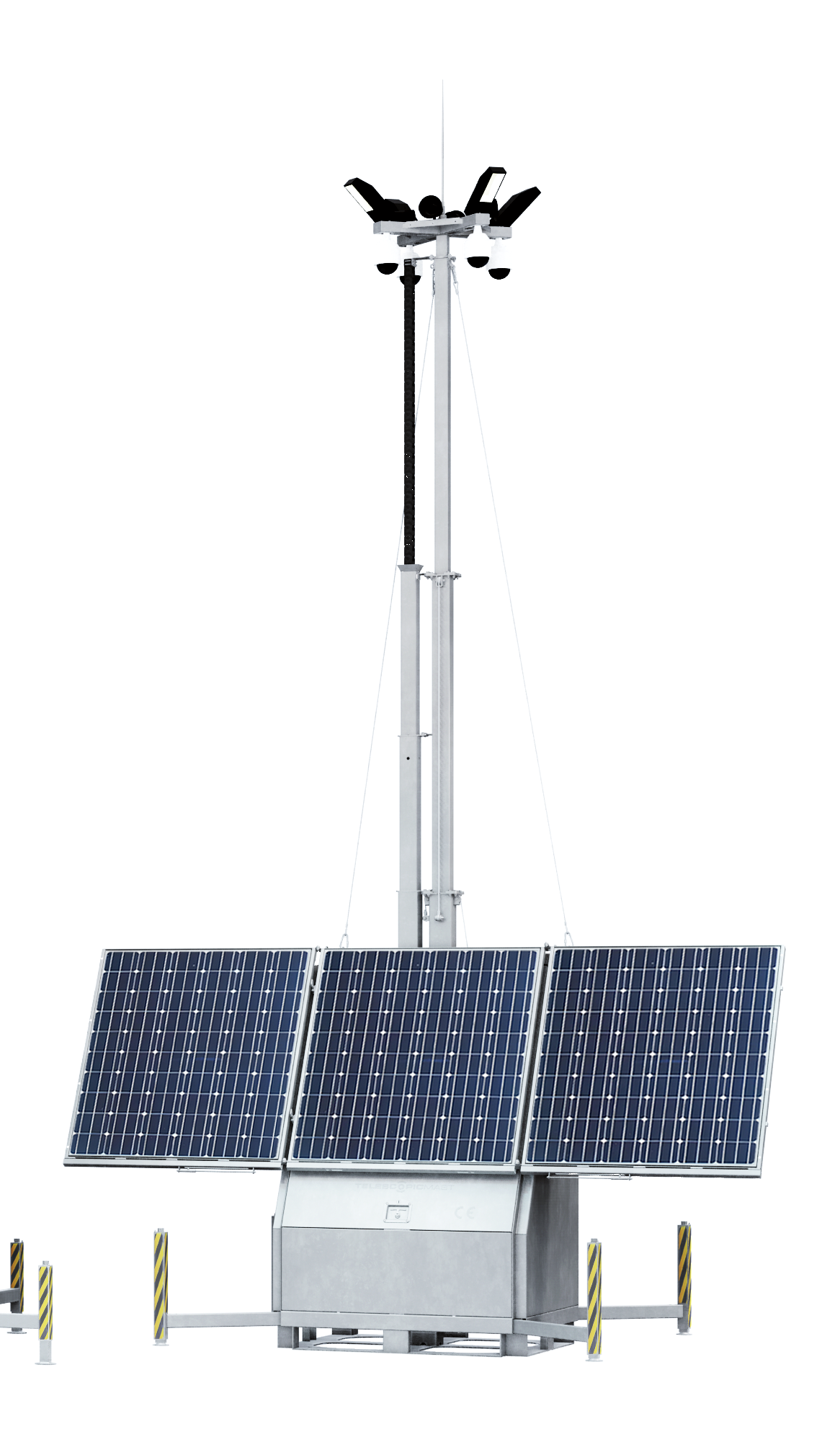
The MSB-Edge exists for exactly this site condition. Three 220 W panels mounted on the platform itself, a galvanised steel cabinet with room for your own battery bank, and a telescopic mast that extends to 501 cm. No trench, no meter, no outage window, no permission from the asset owner’s electrical engineer.
Where the payload or the sightline calls for more height, the same logic applies further up the range: the MSB6 platforms reach six metres and the MSB-Premium XL reaches 900 cm, with mains, battery, solar or fuel cell underneath depending on what the site allows.
The practical difference is that your detection position stops depending on the part of the project that is slowest to change. No waiting on a civils package to secure a site that is already holding stock.
A detection layer you can re-layer
Nobody serious argues that a mast replaces a fence. Fencing, access control at the gate and monitored CCTV each do a job the others cannot, and a solar site needs all three. The gap in most solar farm security designs is not a missing layer. It is that every layer is bolted down.
A platform on a galvanised base can be repositioned by the site team in under 15 minutes, which means the detection layer follows the risk instead of documenting where the risk used to be. Cable pull starting at the north east corner becomes a Tuesday morning job, not a variation order.
That same mobility is what makes the platform work across the whole project rather than one phase of it. See how it applies to perimeter security and intrusion detection, theft prevention and asset protection and remote site monitoring, or at the sector level across critical infrastructure and energy sites.
What is not in the crate
Worth being direct about this, because it is the part that gets misread. A TelescopicMast platform ships as a galvanised steel mast and cabinet with pre-drilled mounting points. No cameras. No analytics. No SIM, no VMS, no monitoring contract.
That is deliberate. Your client’s spec might call for Axis optics and Scylla analytics on one site and something entirely different on the next, and the tender you are bidding may name a brand you have never quoted before. A brand neutral platform lets you say yes to all of it. Technology Partners including Axis, Scylla, Teltonika, Milestone and SFC Energy supply what runs on top. The platform is the foundation your solution is built on, and nothing more than that.
For installers and system integrators, that is usually the whole argument: one platform that does not create a brand conflict with the client.
The evidence the tender file will ask for
Renewable energy clients and their insurers ask for proof, and a solar farm is often a financed asset with conditions attached to it. Every platform is CE certified by TÜV Rheinland, backed by a 95 page test document, built under ISO 9001 and also certified to ANSI and NEN standards. That is a tender annex, not a claim.
The physical side matters too, because an unmanned site invites people to try. Fully galvanised steel with a service life of ten years or more, anti-climb barriers, anti-vandal spikes, lockable doors, lockable top covers and a double brake winch system. The platform is designed on the assumption that it will be the only thing standing in a field at three in the morning.
Frequently asked questions
Can a solar powered CCTV tower run through a northern European winter?
It depends entirely on the payload draw and how the battery bank is sized, which is your calculation as the integrator, not the platform’s. The MSB-Edge supplies the panels, the cabinet space and the mounting; you size the storage to the cameras and the radio you are fitting. For sites where December yield will not carry the load, a fuel cell alongside the panels is the usual hybrid answer.
Does a Mobile Tower Platform replace perimeter fencing?
No. Fencing delays entry and defines the boundary. The platform gives you detection, deterrence and recorded evidence above that boundary. A solar farm security design needs both, plus a monitored route back to an ARC.
How long does deployment actually take?
Under 15 minutes, by one person, with no groundwork and no grid connection. There are no wheels or tyres involved, which also means there is nothing on the unit to steal or deflate while it stands there unattended.
What happens to the units when the solar farm is commissioned?
They move to the next site. Up to 22 masts fit on a single truck, which is why the economics tend to work better for integrators and rental fleets than a comparable number of trailer units, each with its own plates, registration and insurance.
Talk it through against a real site
Every solar farm brief comes down to the same three unknowns: how much payload goes up, how long it has to run unattended, and how often the position needs to move. Give us those three and the platform choice tends to answer itself. What does your next site look like?
Key Takeaways
- 1
A solar farm exports power and distributes none of it at the fence line, so the detection position has to bring its own.
- 2
The theft target moves between construction, commissioning and operation. A camera position specified in month one is pointed the wrong way by month nine.
- 3
Elevation is what gives video analytics the depression angle to tell a person from an animal, and it is what keeps false alarms off the ARC.
- 4
The MSB-Edge carries three 220 W panels and a galvanised cabinet sized for your own battery bank: no trench, no meter, no outage window.
- 5
Cameras, analytics and monitoring are not included. The platform is the foundation your technology partners build on.