Security of military sites with mobile security towers
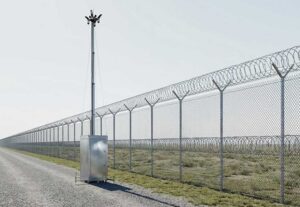
Airports and ammunition depots are at the heart of national defence. Their extensive perimeters, open spaces and mixed traffic create numerous areas where intruders can move undetected. Mobile security towers, with masts up to nine metres high, provide commanders with an additional visible surveillance presence around these sensitive locations. The towers provide observation points in areas that previously lacked direct oversight, strengthening the security of military sites without the need for permanent construction.
Airports and ammunition depots face complex physical threats
Airports and ammunition depots combine runways, vehicle routes, storage compounds and operational buildings within a single perimeter. Long fence lines, service roads and remote hardstanding create zones with limited direct supervision from guards on foot.
Over the past months, several military sites around the world have reported sightings of drones above or near restricted areas. These low-flying devices can map layouts, observe routines, and monitor the movement of units between aircraft stands, magazines, and gates without crossing the perimeter. This combination of ground and air threats means planners must create a surveillance system that covers more than just fixed cameras on building walls.
Key physical threats to military sites include perimeter breaches and intruders on foot
Unauthorised entry along fence lines and service gates remains a major security concern for military sites. Intruders can exploit low light levels, vegetation and complex terrain to move across airfields, remote storage areas and loading bays without being detected early on. When patrols focus on runways, aircraft stands or magazines, other parts of the perimeter may receive less attention at night or in bad weather.
Vehicle-based threats and unauthorised access to restricted zones
Vehicles may attempt to enter controlled zones around runways, aprons, or ammunition compounds. Approach roads, logistics routes and airside service lanes bring many vehicles close to critical areas each day. If these flows are not monitored carefully, gate staff may struggle to spot suspicious behaviour, especially when traffic increases during deployments or training events.
Theft, sabotage and insider activity around weapons, fuel and critical equipment must be prevented
Sensitive supplies such as ammunition, explosives, fuel and communication systems must be kept under constant surveillance. Theft, sabotage or unauthorised handling in these areas can disrupt operations and create a wider safety risk. Insider threats add another layer of complexity because employees or contractors with passes can access areas that are difficult to view from the perimeter.
Mobile security towers can strengthen the security of military objects
Mobile security towers provide raised observation points, secure housing for equipment, and a visible signal that an area is under surveillance. Each tower forms part of a wider, layered security plan that also includes patrols, access control and fixed systems.
- Elevated observation of perimeters and approach routes
With mast heights of up to nine metres, the towers lift cameras, sensors and watch points well above parked vehicles, obstacles and fencing. This helps observers to see deeper along fence lines, approach roads and open aprons, enabling them to spot intruders or suspicious vehicles earlier. Even when technology is not installed, a raised platform placed at key junctions gives guards a better angle for visual checks and the use of binoculars.
- Towers can be moved to provide coverage during changing operations and threat levels
Military sites often change. Flight schedules, training cycles, construction work and the arrival of new units all affect where people, vehicles and equipment move. Mobile security towers can be moved into new positions as the situation on the ground changes, ensuring that coverage follows the zones posing the greatest risk. During periods of heightened threat, additional towers can be brought in to guard temporary car parks, aircraft dispersal areas, and extra storage compounds.
- Towers can be linked with command centres and guard teams
When the towers are equipped with cameras, microphones and speakers, they can feed live images and sound to remote monitoring rooms via 4G or 5G networks. Operators can then watch key zones, issue spoken warnings and guide patrols on the ground towards any suspicious activity. This setup transforms each tower into a hub, connecting local guard teams, central monitoring, and command structures within a shared environment.
Mobile security towers for defence applications
Defence sites require platforms that can operate outdoors for long periods and withstand tampering attempts. Modern mobile security towers combine a robust base unit with a telescopic mast and space for power and communication hardware. The equipment inside the base is shielded from the weather and unauthorised access, while the mast can carry cameras or other devices at height.
- Robust construction for high-risk locations
Many tower cabinets use galvanised steel shells that resist corrosion and provide a heavy, stable base. The extra weight makes it more difficult to push a tower over or move it without lifting tools. Lockable doors, reinforced internal frames and protective covers help to shield power systems and electronics from forced entry and harsh weather conditions in exposed military locations.
- Optional cameras, detection systems and audio equipment provide proactive site protection
The core of a mobile security tower is its physical structure. Cameras, detection devices, loudspeakers and lighting are optional modules that can be added or removed according to mission requirements. For example, a single tower might carry fixed cameras for general viewing, a pan-tilt-zoom unit for close examination, or thermal devices for night-time use. Another tower on the same site may be almost empty, serving mainly as an elevated watchpoint for patrols. This modular approach enables defence users to adapt each tower to the specific threat at that location.
- Power and communications are essential for remote or off-grid military installations
Many military sites have key compounds far from main buildings. Mobile security towers can be powered from the mains where available, or from battery, solar and fuel cell systems where cables are impractical. These options enable the towers to remain operational at remote ammunition depots, temporary helicopter landing grounds, and isolated fuel points for extended periods. Communication links via 4G or 5G can transmit images and alerts to monitoring rooms, eliminating the need for fixed lines.
Use cases include airports and ammunition depots
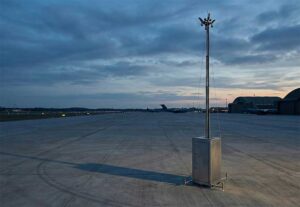 Mobile security towers can bolster the security of military sites at various levels, from routine guard duties to rapid deployment operations. The examples below demonstrate how careful positioning can enhance coverage without the need for significant construction work.
- They can be used to secure airside perimeters, access roads and operational deployment zones
Airside perimeters and access roads require an early warning system to detect movement towards runways and aircraft stands by people or vehicles. Towers placed along perimeter tracks, approach routes and gate lines provide unobstructed views of traffic and eliminate blind spots between fixed poles or buildings.
During operational deployment, large quantities of equipment often arrive by truck or container and may remain unattended while units organise tasks. If mobile security towers are positioned and raised before unloading begins, the entire offloading process can be observed, from the first pallet to the final vehicle. This simple step strengthens the security of military assets at a time when they are outside stores and guard routines are still being established.
- Monitoring of ammunition and explosive storage compounds
Storage bunkers, earth-covered magazines and explosive loading points are usually located away from main buildings for safety reasons. Towers positioned near entry roads, internal junctions, and loading aprons provide a constant view of people and vehicles moving within these controlled areas. When cameras or detection devices are installed, monitoring rooms can establish clear guidelines so that alerts are triggered when movement occurs outside of the agreed time windows. - Protecting temporary works and construction zones on active bases
Construction projects on active bases involve bringing cranes, scaffolding, new access points and contractor compounds inside the perimeter. Ground layouts can change quickly, potentially obstructing the view of existing fixed cameras. Mobile security towers placed at the edge of work zones, near temporary gates or beside valuable equipment keep these dynamic areas under surveillance until the projects are finished.
Planning guidance for defence and government buyers
National defence bodies, infrastructure agencies, and site security companies often collaborate on securing military sites. Mobile security towers form part of this cooperation and require clear planning from the outset.
Site risks should be assessed and the most beneficial locations for the towers identified
Planners can start by mapping current camera views, guard routes, radar coverage and access control points. Overlaying recent incidents, near misses and drone sightings then shows which parts of the site are of greatest concern. Towers should first be allocated to long fence lines, remote compounds and deployment areas where equipment is handled in the open. This method ensures that each additional tower maximises security for military objects within the available budget.
They should work with site security companies and monitoring centres
Many defence users rely on specialist site security companies or integrators to build and operate mobile surveillance capabilities. Early in the planning phase, the parties should agree on how the towers will be used and which monitoring centre will oversee them. There also needs to be a clear route for alerts to reach on-site forces via radios, phones or digital dispatch tools. Clear procedures for raising the mast, testing devices, confirming alarms and dispatching patrols help to ensure that the system complies with local rules and safety requirements.
The next steps for strengthening the security of military objects are as follows
Mobile security towers help defence and government organisations to strengthen the security of military sites. They combine height, mobility and optional technology on a single platform. When planned carefully, they provide an early warning system for vulnerable areas, protect remote compounds and oversee hectic deployment phases when equipment is first removed from storage. Treating towers as one element in a layered defence enables planners to respond to drones and long-standing challenges on the ground.